
Monday, July 13, 2015

Tuesday, June 9, 2015
Wednesday, November 12, 2014
Wednesday, September 14, 2011
The Towers
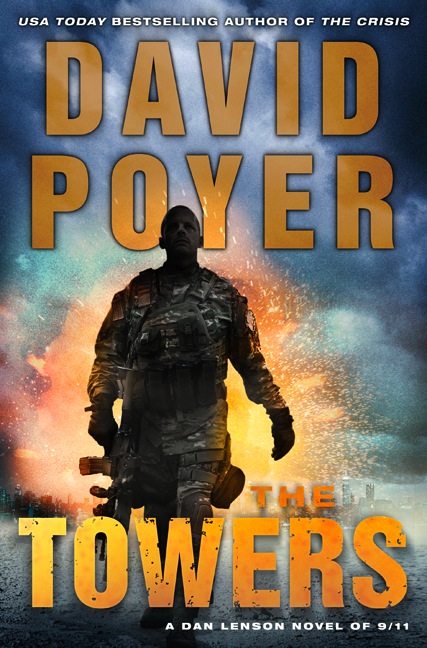
David Poyer
St. Martin's Press
320 pgs.
I'll Be Honest...
This book will take you back to arguably the most important event in America's history. David Poyer's latest novel, featuring his recurring character, Commander Dan Lenson, USN, begins with Lenson's visit to the Pentagon and his wife's visit to the World Trade Center on September, 11, 2001. Also included in the novel is SEAL Teddy Oberg and Special Agent Aisha Ar-Rahim. None of these characters meet one another, rather the reader is brought through different aspects of the momentous event and its aftermath. Lenson's trail follows the strike on the Pentagon and then the military's response in trying to locate the enemy from a grand perspective. Lenson's wife, Blair, is visiting the Twin Towers for a job interview. Teddy takes the reader for the boots-on-the-ground perspective of soldiers searching for the enemy. Aisha not only shows one of the missions leading up to the Towers, but also how people reacted.
Make no mistake, this novel will take you back. Poyer's writing is powerful and honest. Each journey is unique and they intertwine with one another to create the full picture on how the country was dealing with the event from both a military and personal perspective. It's not often that you will be reading and be so emotionally engaged with the environment, but the description of certain passages, whether it is inf the staircase in one of the Towers or the cold, jagged mountains of Afghanistan, are so perfectly rendered that you can't help but be there. And there are no Rambos in this novel. This novel details how the military did/would react to an event like this, and each character has a history and vulnerabilities that you see in the person next to you. This is not to say that they are not heroes, as events such as this show how certain people can do actions that seem superhuman.
So to be honest, I say go out and read this novel. The novel would be classified under Military Fiction, but is a great representation of the event that we all went through. As a retired naval officer, Poyer is able to bring an accurate representation of how motions were put into place, as well as the general tone of the conversations between soldiers. It is a novel that now, during the 10th anniversary of 9/11, brings you back to what we experienced.
Friday, January 21, 2011
I'd Know You Anywhere

I'd Know You Anywhere
Laura Lippman
William Morrow
384 pgs.
I'll Be Honest...
This will not be the longest review that has graced this blog. Not because the book doesn't merit a long review, but because of the subject. I'd Know You Anywhere deals with a woman who was kidnapped for a period of time when she was younger, and how she finally faces her demons. I've mentioned the book to several of my friends, and a few of them decided they probably would not enjoy reading the book. Not because they didn't think it sounded good, but because they were parents. A book about young teens getting kidnapped is not a subject that appeals to parents, and for good reason. However, if you can get past that major hurdle, this book is worth your while.
Eliza was kidnapped when she was in her mid teens by Walter Bowman, a strange but charismatic young man. She manages to escape and return home when Walter is finally arrested, but did things really happen as the media portrayed? Walter was pretty silent in the trial, and hasn't said much since while sitting on death row waiting for his execution over the last 20some years. Finally, he notices Eliza's picture in a magazine and decides it's time for the truth to come out...
Lippman does a great job of moving the main story along while simultaneously jumping back to the past. Her main characters are well constructed, but there are moments in the book that the characters (especially Eliza) act unrealistically. Also, some of the supporting characters seem clichéd (mainly Eliza's sister and the woman helping Bowman). Nevertheless, I'd Know You Anywhere is a page-turner that will have you skimming through in a few days. However, while being an enjoyable ride, you will not reflect on it beyond the theme of safety for children and teens.
Wednesday, November 3, 2010
Worth Dying For

Worth Dying For
Lee Child
Delacorte Press
400 pgs.
I'll Be Honest...
I can't get enough of Lee Child's Jack Reacher series. I freely admit that it's a guilty pleasure, and honestly I don't care who sees me reading it. Shakespeare? Poe? Dickens? Angelou? None of these authors can entertain me on the level that Lee Child does!! Worth Dying For is the latest novel written by Child, following his quota of about a book a year, which when you think about it is quite phenomenal production. It's just such a great series!! Imagine reading how Reacher kicks through a steel door to incapacitate the bad guy, and either rescue the kid or townspeople. And you, sitting there, riveted; reading how this man is able to make the world tremble by flexing and there you are cheering out loud as you sit there in your pjs, surrounded by empty Mountain Dew cans and little bits of Cheetos scattered everywhere.
Jack Reacher, the star of Child's series, is a 6'5, 250 pound ex-MP who travels the United States (mostly on foot) running into situation after situation. He grew up on military bases his entire life until his early 30s when, after realizing the military was going to continue shrinking with the end of the Cold War, he retired and decided to set off and see his home country. He has his own brand of justice, but it's not the wrong kind of justice. How can it be? He's the personification of the country itself, or at least the image that the country has of itself. He's big...huge in fact. He's strong...almost superhumanly strong. He's just shy of being something that burst out of a comic book, and gosh darnit he's not just strong but also smart!! How great is this?! He not only beats up the bad guys, but he solves crimes that are sometimes over 20 years old. What I think is the best part is this "realistic" walking, talking, smacking, smooching giant that either is a perfect representation of the country or a perfect parody of it is written by an Englishman. Go figure
Starting to see why this is a guilty pleasure? But the fact is that the Jack Reacher series are well written (well, decently written for this type of book. The first one, The Killing Floor, won an award but that's as close as this series is going to get to being seen as a literary treasure). In Worth Dying For, Reacher finds himself in the middle of Nebraska. Not only that, but he's stuck in a small town under feudal rule of the Duncan family who employs former college football players as the muscle. Oh, and Reacher is hurt/injured from the previous novel, 61 Hours. Oh, and there are more guys on the way from Vegas, hired mob enforcers, that are going to join the party. Will he make it?? Bwahahahaha! *gasp* *gasp* Haaahahaha...
So to be honest, I still love the Reacher series by Child. Child's writing is fluid, he keeps the tension and action and mystery jacked up so it forces you to read "just 1 more page." I'm someone that has a "fun" read list and a "classics" list, and Lee Child's Jack Reacher series knocked off the John Sandford "Prey" series as the most fun. Worth Dying For is not the best one of the series (personally, I feel that belongs to either One Shot or The Hard Way), but it's not bad. Each book is about 400 pages but it shouldn't take you more than a couple days to read. Also, while it is a series, you definitely do not have to read it in order. I didn't, and I don't think I missed out much. Now and then books will reference previous ones in the series, but with a series like this you know how each will end. So if after reading a Reacher novel you find yourself pumped with testosterone, strapping on your boots, and going out to hitchhike and cross the country, please, pretty please go and read a Jane Austen to bring you back down. The world can't handle two Reachers.
Monday, November 1, 2010
At Home: A Short History of Private Life

At Home: A Short History of Private Life
Bill Bryson
Doubleday
512 pgs.
I'll Be Honest...
I'm a curious person. While tying my shoe I'll often think to myself, "I wonder who invented this process? How long has it been around??" Or have you ever started writing on a piece of paper with a pen when, in a moment of perfect balance between clarity and insanity you focus on where the pen meets the paper and concentrate on the process of writing?? It'll screw you up, guaranteed. It reminds me of when I was about 9 years old and I thought about breathing. Now, breathing is something I do every day, but if you think about breathing (inhaling, exhaling, inhaling, etc.) it's impossible to do it naturally! Most of the time breathing is a natural function that you do without even thinking about, but once you do think about it, you must actively do it until you get distracted again.
Now, what does all of this have to do with Bill Bryson's new book, "At Home: A Short History of Private Life??" It's about the history of those menial, inconsequential items all around you that you never thought about (presumably), for if you did things would get a little out of hand. For instance, did you ever wonder why salt and pepper is on almost every table?? Or even how it was created? Table salt is one of those things that is actually quite perplexing. The human body needs salt, that's not debatable. The creation of salt (sodium chloride) is odd, too. As Bryson points out:
"drop a lump of pure sodium into a bucket of water and it will explode with enough force to kill. Chlorine is even more deadly. It was the active ingredient in the poison gases of the First World War and, as swimmers know, even in very dilute form it makes the eyes sting. Yet we put these two aggressive elements together, and what you get is innocuous sodium chloride-common table salt."
Bryson lives in a Victorian parsonage in the English countryside. He basically tours the house, breaking up the book into chapters that represent each section of the house. The tour begins in the hall and ends in the attic. And in each section he goes into the history of the room and the history of many of the items that are involved. When he gets to the bathroom, for instance, he gives an interesting, albeit disgusting, history of indoor plumbing in the Western World.
Bryson is not perfect. You have to realize when you read him that, while his research has been diligent, I'm sure, you have to take everything with a grain of salt. Don't just accept him at his word. Remember the information and go research certain topics he discusses at your leisure (at your public library, natch). But when you read that it's not truly an urban myth for rats to crawl up sewer pipes and come out your toilet, or that back in the day those moving lumps one felt in his/her bed mattress was, indeed, more rats, OR back when big hair was the style (and I mean towering...women had hair that made them 3 feet taller) some women fainted when they discovered mice had nested in the "upper decks," go and research it to see if that actually did happen!
The point is the book is interesting. It will spark your curiosity about the best things possible - everyday things. When you look around you, every item you see, every custom you witness has a history to it. It had to start somewhere. But how was it created? What is its origin?? Don't you ever wonder why there's summer break for most schools?? (hint: has to do with farming). Didn't you ever think about where the saying "Cleanliness is next to Godliness" came from?? (answer: John Wesley, founder of Methodism, in 1778. And, unfortunately, he was talking about clothes, not the body).
So to be honest, I'd highly recommend reading "At Home: A Short History of Private Life." It is not perfect, like I said. It's very focused on the Western World, but it's centered around an English house so you can't necessarily fault Bryson for this. But his writing is very humorous, and the content in the book pours out. Can you honestly say that you wondered if there was an equation to ensure staircase comfort?? Well there is and it's on page 312. How about the changing of diet over the years?
The average Londoner in 1851 ate 31.8 pounds of onions, as against 13.2 pounds today; consumed over 40 pounds of turnips and rutabagas, compared with 2.3 pounds today; and packed away almost 70 pounds of cabbages per year, as against 21 pounds now. Sugar consumption was about 30 pounds a head - less than a third the amount consumed today.
Yeah...things have changed. But at the same time they haven't. Most of the items we use have been for a very, very long time. Do you know where they came from?? I thought not.
Subscribe to:
Posts (Atom)